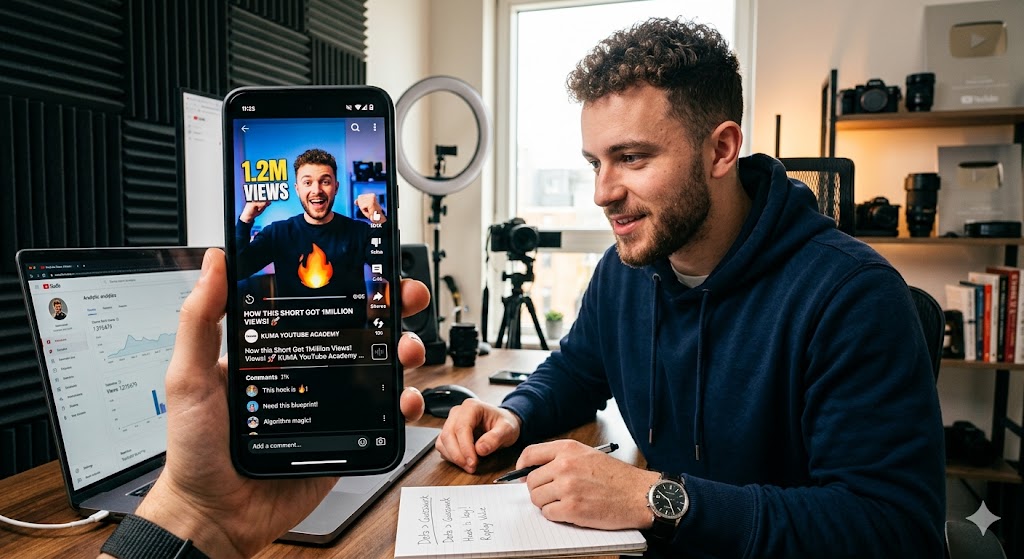
In an era where attention is the most valuable currency, our digital habits have undergone a tectonic shift: we are no longer settling in for a cinematic feature-length experience, but instead gravitating toward the rapid-fire allure of “snackable” content. As noted by Cristobal (2026), the rise of high-velocity, short-form video has fundamentally rewritten the rules of engagement, turning minutes of spare time into a playground for viral discovery and leaving the traditional long-form scroll behind in the dust.
In the traditional YouTube ecosystem, a viewer is often faced with a “choice paradox.” When landing on the homepage or a subscription feed, the user must evaluate thumbnail titles, video lengths, and channel credibility, then actively decide to commit 10 to 30 minutes of their time to a video. This requires cognitive effort and carries the risk of “buyer’s remorse”—investing time in a video that turns out to be boring.
The Shorts feed fundamentally alters this dynamic by transforming content consumption from an active selection process into a passive, immersive experience. Here is how the endless, algorithmic loop effectively eliminates decision paralysis:
1. Shift from “Select” to “Experience”
In the Shorts feed, the platform does the heavy lifting. The user does not “choose” the next video; they simply exist within a stream. By removing the need to click, scroll through search results, or evaluate a homepage menu, the friction between finishing one video and starting the next is reduced to a single, reflexive swipe. This minimizes the cognitive “reset” that usually occurs between videos, keeping the user in a state of flow.
2. The Algorithmic “Predictive Engine”
Because the loop is endless, the algorithm treats every swipe as a high-fidelity data point.
Instant Feedback: If a user swipes away after only two seconds, the algorithm immediately learns what does not appeal to that user.
Calibration: If a user watches a 60-second video to completion or re-watches it (a “loop”), the algorithm identifies a high-value signal.
Eliminating Boredom: By continuously serving content that aligns with the user’s past behaviors, the algorithm keeps the content “fresh” and relevant enough that the user never feels the need to pause and find something better.
3. The “Micro-Commitment” Advantage
The psychological barrier to watching a 60-second video is significantly lower than that of a 20-minute video. Because the time commitment is so low, the user’s threshold for “acceptability” changes. The algorithm exploits this by serving a variety of content types—humor, education, quick hacks—allowing the user to skip what doesn’t immediately resonate without the guilt of “abandoning” a long-form video. The endless loop turns the entire experience into a game of discovery, where the next “reward” (an interesting or funny video) is always just one gesture away.
4. Ambient Consumption
This design is specifically optimized for what researchers call “ambient” or “snackable” consumption (Guerra, n.d.). By automating the transition between clips, YouTube removes the decision-making point entirely, effectively turning the app into a television channel where the programming is perfectly curated to the viewer’s taste in real-time. The viewer is no longer a “selector”; they are a “receiver,” which is far more conducive to long, uninterrupted viewing sessions.
How YouTube algorithm recommendation, engine test and distribute content
The “high-velocity” nature of YouTube Shorts stems from a test-and-expand architectural model that is fundamentally different from the traditional, discovery-based model used for long-form video. Because Shorts are consumed in an endless, passive feed, the platform can gather statistically significant data on viewer behavior in a fraction of the time required for a 10-minute video.
How the High-Velocity Signal Loop Works
When you publish a Short, YouTube immediately injects it into a small, targeted “seed audience.” This group is selected based on metadata (title, tags), the audio/music used, and the video’s content (detected via computer vision).
Because the content is short, the algorithm collects data points almost instantly. It specifically monitors: Swipe-away Rate: The most critical negative signal. If a viewer swipes immediately, it is a high-confidence signal that the “hook” failed.
Watch-through/Completion Rate: A strong positive signal. Completing a video (or rewatching it) indicates that the content met or exceeded viewer expectations. Engagement Density: Interactions like likes, comments, and shares are compressed into a very short timeframe, giving the algorithm a burst” of positive reinforcement.
If the initial seed group shows high engagement, the algorithm immediately pushes the content to a slightly larger cohort. This is an iterative cycle: the video is tested, metrics are validated, and if performance holds, it is pushed to a wider audience. This can happen multiple times within a few hours, allowing a video to scale from 100 views to 100,000+ extremely quickly if the engagement signals remain consistent.
how the platform leverages user data to tailor the feed, keeping engagement high by serving relevant “short and sweet” content
The YouTube Shorts feed acts as a hyper-personalized recommendation engine that processes massive amounts of data in real-time to curate a “snackable” experience. Unlike traditional search, which is intent-driven, the Shorts feed is discovery-driven, relying on behavioral signals to predict what will hold a user’s attention next. Here is how the platform leverages user data to tailor the feed:
1. Behavioral Feedback Loops
The algorithm evaluates every interaction to map a user’s immediate preferences. It tracks: Active Engagement: Likes, comments, shares, and subscriptions provide explicit signals of satisfaction. Passive Signals: The most critical data points are watch time, completion rates, and repeat views. If a user watches a Short to the end or lets it loop, the system views this as a “high-relevance” signal, immediately queuing similar content. Negative Feedback: “Swiping away” is a powerful, instantaneous signal. A high swipe-away rate in the first few seconds tells the algorithm to stop promoting that specific video, effectively filtering out content that doesn’t “hook” the audience.
2. Personalized Contextual Mapping
YouTube’s recommendation system builds a dynamic profile of each user by synthesizing over 80 billion signals (Google, 2026). The algorithm factors in: Watch & Search History: It analyzes what a user has historically enjoyed to identify thematic niches (e.g., cooking, gaming, or quick science facts).
Current Session Context: The system is aware of the “context” of a viewing session. It notes the time of day and device type to refine recommendations—for example, recognizing that a user might prefer shorter, faster-paced content on a mobile device during a morning commute versus longer content on a TV at night (Google, 2026).
Lookalike Modeling: The system identifies other users with similar viewing habits. If “User A” and “User B” have highly overlapping watch histories, the algorithm will test showing content that “User B” loved to “User A.”
3. The “Seed Audience” Strategy
The platform does not blast a new Short to a massive audience immediately. Instead, it employs an explore-and-exploit phase:
Seed Testing: A new Short is first shown to a small, targeted “seed audience” that aligns with the video’s metadata (hashtags, title, and topic).
Scaling: If that initial group engages positively, the algorithm concludes the content has broader appeal and systematically expands the reach to larger, slightly different audience segments.
4. Supporting “Snackable” Content Creation
As noted by Cristobal et al. (2026), the rise of generative AI tools—such as those explored in the PaperTok study—is lowering the barrier for creators to produce this high-velocity content. These tools help creators synthesize complex information into the “short and sweet” formats that the algorithm thrives on, ensuring a constant supply of high-quality, dense, and engaging videos that keep users within the infinite-scroll loop.
short videos (typically under 60 seconds) require less commitment from the viewer.
The YouTube Shorts feed acts as a hyper-personalized recommendation engine that processes massive amounts of data in real-time to curate a “snackable” experience. Unlike traditional search, which is intent-driven, the Shorts feed is discovery-driven, relying on behavioral signals to predict what will hold a user’s attention next. Here is how the platform leverages user data to tailor the feed:
Here is how the platform leverages user data to tailor the feed:
1. Behavioral Feedback Loops
The algorithm evaluates every interaction to map a user’s immediate preferences. It tracks:
Likes, comments, shares, and subscriptions provide explicit signals of satisfaction.
- Integrated Revenue Sharing (The YPP Model): Unlike earlier models that relied on fixed creator funds, YouTube now incorporates Shorts into the YouTube Partner Program (YPP). Monetizing creators receive a 45% share of ad revenue generated from the Shorts feed. This pool-based system scales with the creator’s success—the more views and engagement a creator generates, the more they earn, directly incentivizing high-volume, high-quality production.
- Accessible Milestones: YouTube has lowered the barrier to entry with an “Expanded YPP.” Creators can unlock fan-funding tools (Super Thanks, Channel Memberships, etc.) with as little as 500 subscribers and 3 million Shorts views, allowing new creators to earn income long before they hit the massive thresholds required for full ad revenue sharing.
The most critical data points are watch time, completion rates, and repeat views. If a user watches a Short to the end or lets it loop, the system views this as a “high-relevance” signal, immediately queuing similar content.
Swiping away” is a powerful, instantaneous signal. A high swipe-away rate in the first few seconds tells the algorithm to stop promoting that specific video, effectively filtering out content that doesn’t “hook” the audience.
2. Personalized Contextual Mapping
YouTube’s recommendation system builds a dynamic profile of each user by synthesizing over 80 billion signals (Google, 2026). The algorithm factors in:
It analyzes what a user has historically enjoyed to identify thematic niches (e.g., cooking, gaming, or quick science facts).
The system is aware of the “context” of a viewing session. It notes the time of day and device type to refine recommendations—for example, recognizing that a user might prefer shorter, faster-paced content on a mobile device during a morning commute versus longer content on a TV at night (Google, 2026).
The system identifies other users with similar viewing habits. If “User A” and “User B” have highly overlapping watch histories, the algorithm will test showing content that “User B” loved to “User A.”
3. The “Seed Audience” Strategy
The platform does not blast a new Short to a massive audience immediately. Instead, it employs an explore-and-exploit phase:
Seed Testing: A new Short is first shown to a small, targeted “seed audience” that aligns with the video’s metadata (hashtags, title, and topic).
Scaling: If that initial group engages positively, the algorithm concludes the content has broader appeal and systematically expands the reach to larger, slightly different audience segments.
4. Supporting “Snackable” Content Creation
As noted by Cristobal et al. (2026), the rise of generative AI tools—such as those explored in the PaperTok study—is lowering the barrier for creators to produce this high-velocity content. These tools help creators synthesize complex information into the “short and sweet” formats that the algorithm thrives on, ensuring a constant supply of high-quality, dense, and engaging videos that keep users within the infinite-scroll loop.
YouTube Shorts are easier to consume
Short-form video content has become a dominant force in digital media precisely because it aligns with the modern consumer’s lifestyle—a phenomenon centered on the concept of “micro-moments.” When we discuss “low commitment,” we are referring to how these videos minimize the cognitive and temporal “cost” of consumption. Here is how this dynamic functions:
Traditional long-form content often requires an investment of time and attention that can feel daunting; choosing a 20-minute video requires a “buy-in” from the viewer. In contrast, a 60-second video requires almost no initial commitment. Because the investment is so small, the risk of “wasting time” is perceived as nearly zero, allowing users to engage instantly without needing to evaluate whether a video is “worth it.”
Modern life is full of “in-between” periods—the minutes spent waiting for a bus, standing in line at a grocery store, or during a quick work break. These are micro-moments. Short-form video thrives here because it provides a complete narrative arc (or “dopamine hit”) within a timeframe that fits these gaps.
Unlike a 10-minute video that must be paused or interrupted, a 30-second clip can be consumed from start to finish within a single micro-moment, providing a sense of satisfaction and closure.
These videos are designed for mobile-first consumption, meaning they are easily accessible in any environment without the need for a sustained, focused environment.
Because the content is brief, the relationship between the viewer and the creator is often more casual and authentic. If a viewer doesn’t like a video, they can scroll away in an instant with virtually no penalty. This low-stakes environment encourages users to explore new topics and creators they might otherwise ignore, as they feel free to sample content without “locking in” to a longer viewing experience.
Short videos are engineered to respect the current reality of attention spans. By using rapid editing, immediate “hooks,” and high-density information delivery, they ensure that the viewer receives value—whether it is entertainment, humor, or education—within the first few seconds. This structure respects the user’s time and provides an immediate payoff, reinforcing the habit of checking the feed during even the briefest moments of downtime.
Immediately visual impact and fast passing.
The emphasis on immediate visual impact and fast pacing in short-form content—a concept explored in research like Cristobal et al. (2026)—is a direct response to the “economy of attention” in the digital age.
Viewers today operate in a high-velocity feed where the cost of “swiping away” is virtually zero. Because the brain decides whether to engage with a video almost instantly, creators have a 2–3 second window to provide a “thumb-stopping” hook.
his isn’t just about high production value; it’s about high visual information density. Whether it’s a sudden movement, a bright color contrast, a surprising facial expression, or an unexpected caption, the visual hook signals that the video is worth the “investment” of the viewer’s next 30 seconds.
Modern media consumption is often characterized by micro-moments—short intervals during commutes, lines, or breaks. Research indicates that frequent exposure to short-form content has shifted how we process information, favoring:
Instead of deep, linear narratives, users are now accustomed to “snackable” content that delivers a complete thought or emotional beat in a single burst.
Instead of deep, linear narratives, users are now accustomed to “snackable” content that delivers a complete thought or emotional beat in a single burst.
As noted in studies on student attention spans, the brain becomes conditioned to expect constant updates. Fast pacing (frequent cuts, rapid narration, or dynamic camera movement) prevents the brain from entering a state of “boredom” or perceived stagnation, which is the primary driver for scrolling away.
The study by Cristobal et al. (2026), PaperTok, specifically highlights that this fast-paced, high-impact format is increasingly necessary even for academic and research communication. Because traditional papers are often too “slow” and dense for modern platforms, researchers are leveraging generative AI to condense complex data into snappy, visually-driven video formats. This proves that the need for visual impact is not just an aesthetic choice, but a functional requirement to make information accessible to an audience that has been reshaped by social media consumption habits.
In summary: In an environment where content is abundant and attention is scarce, “immediate visual impact” acts as the filter, and “fast pacing” acts as the engine that keeps the viewer from exiting the loop.
Shorts are perceived as authentic and entertaining
Highly produced content—with studio lighting, professional editing, and scripted dialogue—often creates a psychological distance. It feels like a broadcast from a distant entity. In contrast, “amateur-style” videos feel like a conversation.
Because the creator is often filming on a phone in a natural setting (a bedroom, a kitchen, or a car), the viewer feels like they are hanging out with a peer rather than being sold to by a corporation. This intimacy is a powerful driver of repeat views and loyal subscribers.
There is a concept in media psychology called “perceived effort.” When content feels too polished, the audience subconsciously realizes, “This took a lot of money and a professional team to make.” This can trigger a defensive reaction—the viewer knows they are watching an advertisement or a highly controlled piece of media.
“Amateur” content lowers this defense. The viewer perceives the content as “organic,” which makes them more likely to trust the information being shared. It feels more like a recommendation from a friend than a polished pitch.
The “amateur” aesthetic allows creators to be more responsive to trends.
Speed is a competitive advantage. A creator filming with a phone can react to a meme, a piece of news, or a comment section suggestion in minutes.
High-production studios have a “lead time” (filming, editing, color grading, approval cycles). By the time their video is ready, the conversation has often moved on. Shorts viewers prioritize relevance and timeliness over cinematic quality.
YouTube incentivizes short to competes with other platform like tiktok
How YouTube Incentivizes Creators
To compete with platforms like TikTok and Instagram Reels, YouTube has shifted from a static, fund-based incentive to a robust, long-term revenue-sharing model. This strategy aims to professionalize the short-form space, attracting high-quality creators by offering a predictable and scalable path to monetization.
Accessible Milestones: YouTube has lowered the barrier to entry with an “Expanded YPP.” Creators can unlock fan-funding tools (Super Thanks, Channel Memberships, etc.) with as little as 500 subscribers and 3 million Shorts views, allowing new creators to earn income long before they hit the massive thresholds required for full ad revenue sharing.
A major incentive for established YouTubers is the ability to use Shorts as a top-of-funnel growth engine. YouTube’s algorithm and interface are designed to convert Shorts viewers into long-form subscribers, where CPMs (revenue per 1,000 views) are significantly higher ($1–$30 for long-form vs. $0.03–$0.10 for Shorts). This allows creators to build a sustainable business by leveraging the reach of Shorts and the monetization power of traditional video.
YouTube invests in AI-driven tools that help creators improve their video and audio quality automatically, such as “Voice boost” and “Super resolution.” By reducing the technical friction of editing, the platform encourages a higher volume of polished content.
By replacing the unpredictable, fluctuating payouts of the former “Shorts Fund” with a consistent revenue-share model, YouTube has made Shorts a viable career path rather than a “get-rich-quick” gamble. This stability attracts creators who invest time in content quality rather than just chasing one-off viral trends.
YouTube is a top of funnel marketing tool.
Shorts function as a high-velocity discovery engine, acting as the “top of the funnel” by introducing your brand to audiences that would likely never have encountered your long-form videos through standard search or browse features. Because the Shorts feed is optimized for rapid consumption, it allows you to reach a massive, cold audience with minimal friction.
The Mechanics of the “Shorts-to-Long” Funnel
Use your Short to present a compelling premise, a controversial opinion, or a “how-to” step, then cut the narrative just before the climax or the “big reveal.” By explicitly telling the viewer to “watch the full breakdown in the linked video,” you create a natural curiosity gap that they must visit your main channel to satisfy.
YouTube allows you to link a specific long-form video directly to a Short via the “Related Video” button located near the title. This is the most friction-free conversion path available. Viewers can click directly through without needing to navigate your channel page, significantly reducing the “drop-off” rate.
If you produce complex long-form content (e.g., in-depth tutorials or deep-dive analysis), create a “cliff notes” version as a Short. This demonstrates your expertise and value in under 60 seconds, acting as a low-risk “sample” that builds enough trust to make the viewer feel comfortable committing 10–20 minutes to your full video.
Shorts have a unique “Subscribe” button that appears directly in the feed. When a viewer discovers your channel through a Short, they can subscribe instantly. Once subscribed, they are far more likely to see your long-form content in their “Home” feed, even if they aren’t actively scrolling through Shorts.
Best Practices for Maximizing Conversion
Only link long-form videos that are highly relevant to the Short. If a viewer clicks through to a video on a completely different topic, they will bounce immediately, which hurts your long-form retention metrics.
Don’t waste the first 5 seconds of your Short on a Call-to-Action. Provide 40–50 seconds of value first. Place your verbal or visual cue to watch the long-form video in the final 5–10 seconds, after you have already earned their attention.
Use the same branding (thumbnails, tone, and visual style) in your Shorts as you do in your long-form content. This creates a psychological “continuity” so that when a viewer lands on your main channel, they recognize it instantly as the same high-quality source they enjoyed in the feed.
accessibility of mobile-based editing tools which democratizes content creation,
The accessibility of mobile-based editing tools has fundamentally democratized content creation, effectively lowering the barriers to entry that once defined professional video production. By shifting the power of editing from high-end desktop suites to intuitive, smartphone-native applications, these tools have allowed a much broader demographic to participate in the creator ecosystem.
- Reduced Technical Friction: Modern apps (such as the YouTube Create app, CapCut, or Adobe Premiere Rush) now handle complex tasks—like multi-track timeline editing, color grading, and audio syncing—with simplified, touch-based interfaces. This allows creators to focus on storytelling rather than mastering professional software.
- AI-Assisted Efficiency: The integration of artificial intelligence into mobile workflows (e.g., automated scene detection, AI captioning, and background removal) has further compressed production times. Tasks that once required hours of manual labor can now be automated with a single tap.
- Platform-Native Workflows: Because these tools are often designed to output directly to vertical formats, they align perfectly with the requirements of Shorts. This “capture, edit, and upload” loop enables creators to respond to trends in real-time, which is essential for maintaining visibility in high-frequency content feeds.
- Lowered Financial Barriers: Many of the most effective tools are either free or available at a nominal cost, removing the need for expensive hardware or professional software subscriptions. This ensures that a creator’s success is based on their creativity and engagement strategy, rather than their ability to invest in high-end production infrastructure.
As noted by studies on the creator economy, these platform-mediated advances in computing have effectively lowered the costs of production and distribution, allowing even those with limited technical training to build professional-grade channels (Chu, 2022). This paradigm shift has turned the smartphone into a portable production studio, fueling the massive volume of high-quality content that drives today’s digital platforms.