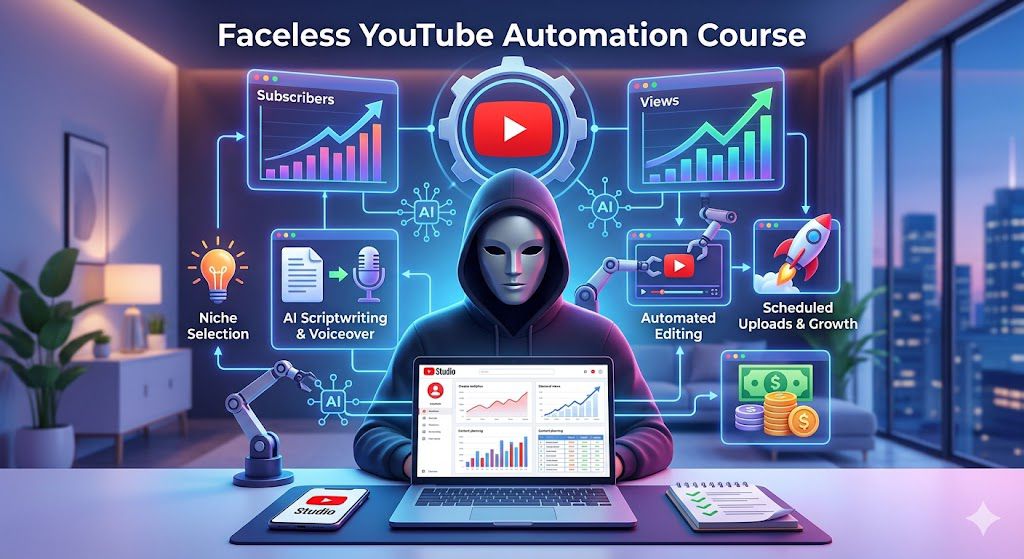
The ultimate goal of automation is passive or semi-passive cash flow. Trying to piece together a strategy from 50 different YouTube gurus slows you down because of information overload and conflicting advice. A faceless YouTube automation course course provides a single, linear timeline from day 0 to your first monetization payout, cutting your learning curve from years down to weeks.
The Bottom Line: A course changes your perspective from looking at YouTube as a creative hobby to managing it as a scalable digital asset. It turns expensive guesswork into a predictable business model.
Let’s be honest—staring down the barrel of a camera lens is an unnatural experience. The moment the red recording light turns on, it’s entirely normal to freeze, stutter, or hyper-analyze every word you say. You worry about how your voice sounds, how your hair looks, and what people from your high school or current job might think if they find the video. For introverts, the sheer mental exhaustion of having to be “on” and energetic for the camera is enough to kill a YouTube channel before it even begins.
What is Faceless YouTube automation
Faceless YouTube Automation is a business model where a creator builds and runs a YouTube channel without ever appearing on camera. Instead of a”Automation” in this context rarely means pressing a single button and letting software run the entire channel. Instead, it refers to removing the channel owner from the physical production process. This is typically achieved through one of two methods:
Human Delegation (The Agency Model): The channel owner hires a remote team of freelancers—such as a scriptwriter, a voiceover artist, a video editor, and a thumbnail designer. The owner simply approves the video topics, manages the team’s workflow, and uploads the final product.
AI Leverage (The Tech Model): The owner uses artificial intelligence tools to handle the heavy lifting. This involves using LLMs for scripting, AI voice generators for narration, and generative AI for stock footage, editing, or illustrations, significantly reducing overhead costs.cting as the “talent” or the face of the brand, the channel owner acts as a producer or project manager.
Think of it as treating a YouTube channel like digital real estate. The goal is to build a scalable media asset—an “assembly line” of videos—that generates ad revenue and affiliate income without relying on a single individual’s personality or daily energy.
The Two Approaches to Automation
“Automation” in this context rarely means pressing a single button and letting software run the entire channel. Instead, it refers to removing the channel owner from the physical production process. This is typically achieved through one of two methods:
Human Delegation (The Agency Model): The channel owner hires a remote team of freelancers—such as a scriptwriter, a voiceover artist, a video editor, and a thumbnail designer. The owner simply approves the video topics, manages the team’s workflow, and uploads the final product.
AI Leverage (The Tech Model): The owner uses artificial intelligence tools to handle the heavy lifting. This involves using LLMs for scripting, AI voice generators for narration, and generative AI for stock footage, editing, or illustrations, significantly reducing overhead costs.
The Assembly Line Method: Shifting from “Talent” to “Producer”
When most people think of starting a YouTube channel, they picture a vlogger: setting up ring lights, doing makeup, memorizing scripts, and spending hours performing in front of a camera. That is the role of the Talent.
Faceless YouTube automation requires a complete mindset shift. You are no longer the Talent; you are the Producer or Director of a digital media company.
Instead of making the product yourself, you are building an assembly line that makes the product for you. Your job is to oversee the factory, ensure quality control, and make the strategic decisions that drive revenue.
Here is how the modern faceless YouTube assembly line is broken down:
Why you need a faceless YouTube automation course
While you can technically find thousands of free tutorials online, trying to build a profitable faceless YouTube channel entirely on your own usually leads to abandoned channels and wasted money.
Investing in a structured course bridges the gap between watching random videos and running a functional, revenue-generating digital business. Here is why a dedicated course is essential for anyone serious about YouTube automation:
1. Navigating YouTube’s Policy Landmines
YouTube’s algorithms and monetization policies change constantly. The biggest risk for faceless channels is getting hit with a “Reused Content” or “Repetitive Content” flag when applying for the YouTube Partner Program.
The Free Route: You guess based on outdated forums, stitch together low-effort AI clips, and get rejected after months of work.
The Course Advantage: You learn the exact framework required to pass monetization reviews—such as how to add human value, structure original commentary, and correctly use AI tools without triggering compliance filters.
2. Turnkey Systems and SOPs (Standard Operating Procedures)
A successful faceless channel does not run on inspiration; it runs on a factory-like assembly line.
A high-quality course doesn’t just teach you what to do—it gives you the blueprint to step away from the daily grind. You receive exact frameworks for:
The Script Formula: A plug-and-play outline that locks in viewer retention in the first 30 seconds.
Workflow Management: Trello or Asana templates to seamlessly pass a video from the scriptwriter to the voice actor, to the editor, and finally to the uploader without your constant supervision.
3. Speed to First Dollar
The ultimate goal of automation is passive or semi-passive cash flow. Trying to piece together a strategy from 50 different YouTube gurus slows you down because of information overload and conflicting advice. A course provides a single, linear timeline from day 0 to your first monetization payout, cutting your learning curve from years down to weeks.
The Bottom Line: A course changes your perspective from looking at YouTube as a creative hobby to managing it as a scalable digital asset. It turns expensive guesswork into a predictable business model.
Some of the best faceless YouTube automation course on the Internet today
Online business academy by dave nick; faceless YouTube automation course
Dave Nick’s Online Business Academy (OBA) is one of the most prominent platforms in the digital monetization space. Analyzing how he structures and prices his flagship faceless YouTube automation courses provides excellent competitive intelligence as you continue to develop and refine the masterclass blueprints for Kuma YouTube Academy.
Here is a breakdown of his curriculum, pricing model, and how the market is currently responding to his strategies in 2026.
Overview of the OBA Faceless Curriculum
Dave Nick doesn’t rely on a single definitive course; OBA hosts several programs. His two primary YouTube automation offerings are: Automation Systems 4.0 ($795): This is his flagship, 58-lesson program. Unlike standard courses that focus solely on reaching YouTube AdSense requirements, this blueprint teaches students how to use faceless YouTube channels as a “traffic tsunami” to drive viewers to external offers, landing pages, and affiliate links. YouTube Shorts Billions ($795): A specialized program focused entirely on short-form, high-velocity vertical video and exploiting the algorithm for rapid view generation.
Curriculum Structure & Methodologies
When pacing a syllabus—whether for a concentrated 10-day certificate course or a longer self-paced program—Dave Nick’s modules focus heavily on creating a scalable “assembly line” for content.
The Content Pipeline: He emphasizes creating an “Automated Creation Flow.” This involves training students to use AI tools for scripting and voiceovers, while outsourcing the editing to produce videos at scale without the creator becoming the bottleneck.
Make money on YouTube with ai by Denis bell
Denis Bell (often known online as @DenisTheMoneyMenace) teaches YouTube automation primarily in association with TubeMagic, a suite of AI tools designed specifically for YouTube creators. His approach focuses on using artificial intelligence to streamline the entire process of running a faceless channel, treating it as a scalable digital business rather than a personal vlog.
Here is the core methodology he outlines for making money on YouTube with AI:
High-Value Niche Selection: He emphasizes choosing high-RPM niches (like finance, tech, or philosophy) that naturally attract advertisers, ensuring the channel has strong earning potential from the start.
AI Content Generation: Bell advocates using AI to bypass traditional video production bottlenecks. This involves utilizing AI tools to write scripts, generate optimized titles and tags, draft descriptions, and even ideate thumbnails. The Viral Formula: His strategy heavily relies on understanding YouTube’s algorithm by optimizing for high click-through rates (CTR) and audience retention.Monetization Strategies: He covers how to actually turn those views into revenue, looking beyond just standard YouTube AdSense.His teachings are closely integrated with the TubeMagic software (a platform founded by Matt Par), which provides the specific AI generators needed to execute this automated workflow.
FAQs on faceless YouTube automation course
What exactly is Faceless YouTube Automation?It is a business model where you run a YouTube channel like a digital media company. Instead of stepping in front of a camera or recording daily vlogs, you act as the channel director. By leveraging smart AI tools and a streamlined workflow, you assemble high-retention videos (script, voiceover, and editing) without ever showing your face.
Do I need a camera or expensive equipment to start?
Not at all. Because you are producing faceless content, you do not need lighting, microphones, or a high-end camera. All you need is an internet connection and a laptop or smartphone. The curriculum focuses on using low-cost and free AI software to launch your channel with minimal upfront capital.
Can I really learn the entire system in just 9 days?
Yes. The masterclass is structured as an intensive step-by-step blueprint spread across 9 days. It cuts out the overwhelming theory and focuses strictly on execution. By the end of the program, you will have selected a high-paying niche, optimized your channel, and mapped out your automated content pipeline.
Will YouTube still monetize AI and faceless content in 2026?
Yes, but the quality standard has changed. YouTube’s 2026 policies actively demonetize low-effort, robotic AI spam. However, they fully support and monetize faceless channels that provide genuine value, high-quality audio, and engaging storytelling. The blueprint teaches you the exact production standards required to get approved for the YouTube Partner Program.
Do I receive anything upon finishing the course?
Yes. Upon successful completion of the 9-day masterclass, you will receive an official certificate. This validates your expertise in digital media and YouTube automation, a skill you can use to build your own assets or offer as a high-income freelance service to other brands.
Does this work if I am managing the channel from outside the US or UK?
Absolutely. One of the biggest advantages of this model is location independence. You can run a faceless YouTube channel targeting high-paying global audiences (like the US, UK, or Canada) from anywhere in the world. As long as you can access the internet, your physical location does not limit your channel’s growth or earning potential.
How soon can I start making money?
Treat this as a scalable digital business, not a get-rich-quick scheme. While you will have your channel set up and running during the masterclass, reaching YouTube’s traditional ad-revenue threshold takes consistency over several months. However, the blueprint also covers day-one monetization strategies—like affiliate marketing and sponsorships—to help you generate revenue while your subscriber base grows.