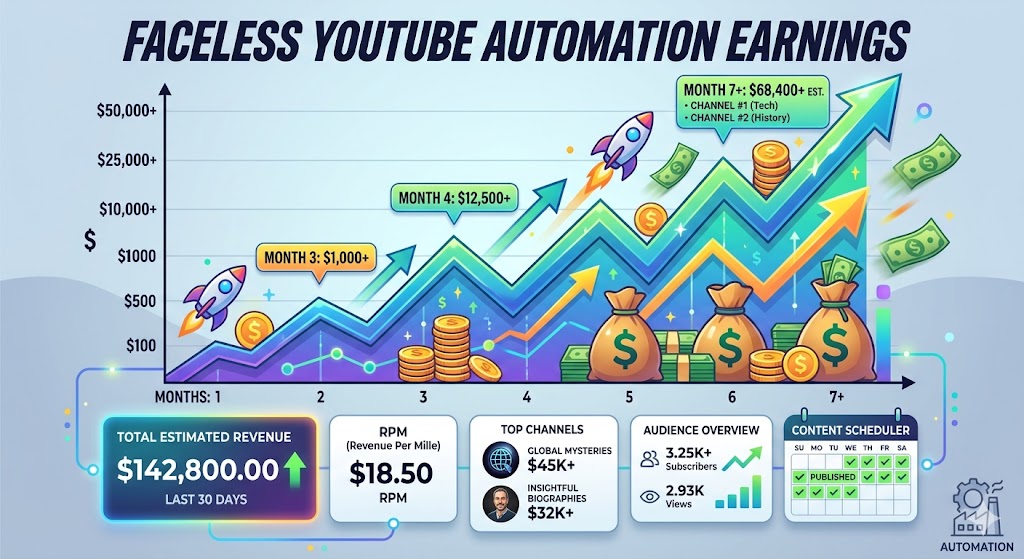
Everywhere you look on social media, “gurus” are selling courses on how to make thousands a month with faceless “cash cow” YouTube channels using AI. This blog post get you through all you need to know about YouTube automation earnings, and how you too can earn from $10k up.
YouTube automation (often called running a “faceless” channel) is a digital business model where you operate and monetize a YouTube channel without ever appearing on camera or recording yourself.
Instead of being a traditional creator, you act as a project manager or producer. You build a content assembly line that handles the video creation process for you.
This is typically executed in two ways:
AI Software: Using tools to generate scripts (like ChatGPT), synthesize realistic voices (like ElevenLabs), and edit visuals.
Freelance Teams: Hiring specialized scriptwriters, voice actors, and video editors (often through platforms like Upwork or Fiverr) to produce the videos on your behalf.
Right mindset for faceless YouTube automation earnings
This is exactly the right mindset to have. The biggest misconception sold by “gurus” is that YouTube automation is a set-it-and-forget-it money printer.
In reality, running a faceless channel is identical to running a digital production agency. You are the executive producer. Here is a deeper dive into exactly why it operates like a traditional business—and what it actually takes to make it profitable.
1. Upfront Capital (The Burn Rate)
Unless you are trading your own time to write, voice, and edit every video (which defeats the purpose of “automation”), you have to buy other people’s time or pay for premium software. You will be operating at a loss for months before YouTube begins paying you. This is one truth about faceless YouTube automation earnings that has to sink in.
You can use this calculator to estimate your actual monthly burn rate based on how many videos you want to produce:
2. Management Skills (The Bottleneck)
When you outsource the work, you don’t eliminate the workload—you change the nature of it. You transition from a creator to a project manager.
If your team is disjointed, your videos will feel disjointed, and viewers will click away. Managing the assembly line requires specific operational skills:
Quality Control (QA): You must review every script for pacing and accuracy. If you hire a cheap writer, you will spend hours rewriting their work to make it engaging.
Asset Management: You have to organize Google Drive folders, ensuring the voiceover matches the script, and the editor has access to both.
Feedback Loops: You have to know how to give precise, actionable feedback to an editor (e.g., “Cut the pause at 2:14, and add a zoom-in on the graph”).
Analytics Interpretation: You must be able to read YouTube Studio metrics (Click-Through Rate and Average View Duration) to figure out why a video failed and instruct your team on how to pivot.
3. Patience (The Algorithm Sandbox)
YouTube does not trust new channels. When you launch, the algorithm has zero data on who your target audience is.
During your first few months, YouTube will test your videos against different viewer demographics. Your metrics (views, click-through rate) will likely be terrible during this phase. Many people quit after 15 videos because they’ve spent $1,500 and have 40 subscribers.
Treating it like a business means understanding that those first 30 videos are not failures; they are data acquisition costs. You are paying to train the algorithm to find your audience.
Your production process vital for your Faceless YouTube automation earnings
The goal here is to build a system where an idea enters one side and a fully produced video exits the other, requiring you only to manage the process rather than do all the manual labor.
1.Topic Research and SEO:
The foundation of the entire video.Before a single word is written, you must prove there is an audience for the video. Automation channels live and die by search volume and recommended algorithms, not personality.The goal is to find a “content gap”—topics with high search interest but low-quality or outdated competition.
The Process: Analyze competitors, find videos that over-performed relative to their channel’s subscriber count, and identify angles that haven’t been covered yet.
Common Tools: VidIQ or TubeBuddy
TubeBuddy for keyword research and competitor analysis; Google Trends to catch rising topics before they peak.
2.Scriptwriting:
Where retention is won or lost.The script is the skeleton of the video. Because you don’t have a charismatic host on camera to hold attention, the writing must be incredibly tight, constantly opening “curiosity loops” to keep viewers engaged.
The Process: Create a strong hook (the first 10 seconds), deliver on the thumbnail’s promise, and structure the content logically. While AI is heavily used here, copying and pasting raw AI output leads to robotic, easily detectable scripts that YouTube may demonetize.
Common Tools: ChatGPT (GPT-4) or Claude for outlining and first drafts. Successful channel owners spend their time editing and injecting human nuance into these AI drafts, or hiring specialized scriptwriters on platforms like upwork
3. Voiceover generation
Human vs. AI.
Once the script is locked, it needs a voice. The standard has moved far beyond the robotic, monotone text-to-speech voices of the past.
The Process: You feed the script into a high-end AI generator or hand it off to a human freelancer. The key is pacing, emotion, and proper emphasis on important words so it sounds natural.
Common Tools: ElevenLabs is currently the industry standard for hyper-realistic AI voices that can mimic human inflection and emotion. Alternatively, hiring a professional voice actor on Fiverr ensures 100% original audio and zero risk of AI-related demonetization issues.
4.Video Editing and Assembly:
The most time-consuming phase
This is where the visual elements are married to the audio. Because there is no talking head, the screen must constantly change to reset the viewer’s attention span—typically a new visual every 3 to 5 seconds.
The Process: The editor pulls high-quality stock footage, creates motion graphics, adds sound effects (whooshes, pops), and overlays text/captions to emphasize key points.
Common Tools: AI video generators like InVideo or Pictory can automate finding b-roll based on the script. However, top-tier channels usually hire human editors using Adobe Premiere Pro or CapCut to ensure precise pacing, seamless transitions, and a premium feel that AI editors still struggle to achieve perfectly.
5.Thumbnail Design and Publishing:
A great video is worthless if nobody clicks on it. The thumbnail and title are treated as a single package designed to maximize the Click-Through Rate (CTR).
The Process: Design 2 to 3 distinct thumbnail concepts for A/B testing. The design should be simple, highly contrasted, and evoke emotion or curiosity with minimal text. Once the video is uploaded, metadata (tags and descriptions) are optimized for search.
Common Tools: Midjourney for generating custom, high-quality base images; Canva or Photoshop for adding text, borders, and color correction.
Faceless YouTube automation earnings; where the money come from.
YouTube earnings refer to the total revenue a content creator generates from their channel through various monetization features provided by the platform, as well as external income streams tied directly to their content.
To me the biggest motivation for starting a faceless YouTube channels is earning, so let’s explain more on how faceless YouTube automation earnings come about.
How YouTube partners program pays out?
The foundation of a faceless channel’s income is the YouTube Partner Program (YPP). Once a channel hits the monetization threshold—currently 1,000 subscribers and either 4,000 watch hours on long-form videos or 10 million Shorts views—YouTube allows advertisers to run commercials before, during, and after the videos.
Google AdSense acts as the payment processor and middleman. Advertisers bid for placement on your content, YouTube collects the money, and then splits it with you. For long-form videos, the split is highly favorable to the creator: you keep 55% of the ad revenue, and YouTube keeps 45%.
However, to accurately project Faceless YouTube automation earnings you have to clearly distinguish between the two most confused metrics in the industry: CPM and RPM.
1. Understanding CPM and faceless YouTube automation earnings
CPM (Cost Per Mille)”Mille” is Latin for thousand. CPM is entirely advertiser-focused. It represents what brands are bidding to get 1,000 ad impressions on your specific content. CPM fluctuates wildly based on commercial intent and geography. If a channel focuses on general entertainment or meme compilations, advertisers won’t pay much because the audience isn’t in a buying mindset (expect a CPM of $1 to $3). But if a channel produces content on high-intent topics like high-performance TikTok advertising, e-commerce, or digital monetization strategies, advertisers are willing to pay a massive premium to reach that audience. In these B2B or finance niches, a $15 to $30+ CPM is common.
2. Understanding RPM
RPM(Revenue Per Mille)RPM is creator-focused. It is the actual money deposited into your AdSense account for every 1,000 views your video gets. Your RPM will always be lower than your CPM for a few key reasons:The YouTube Split: YouTube takes its 45% cut from the CPM right off the top. Monetized vs. Unmonetized Views: CPM only counts views where an ad actually played. RPM calculates your revenue across all views, including those where the viewer used an ad blocker or YouTube simply didn’t serve an ad.
Alternative Revenue: RPM also factors in money you make from YouTube Premium viewers (who don’t see ads) and Super Chats, giving you a holistic view of a video’s actual earning power.
Affiliate marketing another faceless YouTube automation engine
Affiliate marketing is arguably the most powerful revenue engine for a faceless YouTube channel, primarily because you don’t have to wait for YouTube to approve you for the Partner Program to start making money.
With AdSense, you need 1,000 subscribers and 4,000 watch hours before you see a single cent. With affiliate marketing, your very first video could technically generate a sale.
Here is a deep dive into how affiliate marketing functions within the faceless YouTube automation model, and how to actually get viewers to click.
Why It Works So Well for Faceless Channels
Faceless channels thrive on delivering information and solutions. Because viewers aren’t tuning in for a personality, they are highly intent-driven. If your video promises to explain “How to edit videos with AI,” and you provide a clear, helpful tutorial, the viewer is highly likely to click your affiliate link for the AI software you just demonstrated.
You are positioning the channel as a resource, and the affiliate link as the logical next step.
Matching the Affiliate to the Niche
The success of your affiliate links depends entirely on niche alignment. Slapping an Amazon link for a microphone on a video about historical mysteries won’t convert.
Here are how the most profitable faceless niches align with affiliate offers:
Matching the Affiliate to the Niche
The success of your affiliate links depends entirely on niche alignment. Slapping an Amazon link for a microphone on a video about historical mysteries won’t convert.
Here are how the most profitable faceless niches align with affiliate offers:
Software/Tech Tutorials: This is the goldmine. Promote SaaS (Software as a Service) products like web hosting (Bluehost, SiteGround), VPNs (NordVPN, ExpressVPN), or AI tools (Midjourney, Notion, ChatGPT plugins). These often pay recurring commissions—meaning you get a cut every month the user stays subscribed.
Finance & Wealth: Promote trading platforms (Robinhood, Webull), crypto exchanges, budgeting software, or high-ticket courses on side hustles.
Health & Fitness: Focus on digital workout programs, specialized supplements (via ClickBank or Amazon Associates), or meal-prep delivery services.
Travel: Recommend travel insurance, booking platforms (Booking.com, Expedia), or specific travel gear via Amazon.
3 Tactics to Drive Clicks affiliate (Without Showing Your Face)
Having the link in the description isn’t enough; most viewers never open it. You have to actively funnel them there.
1. The On-Screen Call to Action (CTA)
Since you don’t have a human face pointing down at the description, you must rely on your voiceover and visuals.
Audio: Have the voiceover explicitly state the value: “If you want to try this software yourself, I’ve put a link in the description that gives you a 14-day free trial.”
Visual: Use lower-third motion graphics (like an animated arrow pointing downward) while the voiceover makes the pitch.
2. The Pinned Comment Strategy
The description is often collapsed by default, especially on mobile. The comment section, however, is a high-traffic area. Always paste your affiliate link in a comment, pin it to the top, and give a reason to click (e.g., “👇 Grab your exclusive 20% discount on [Tool Name] here:”).
3. “Show, Don’t Just Tell”
If you are promoting a tool or piece of software, your video needs to show the interface in action. Viewers need to see the result the tool generates before they feel compelled to buy it. Stock footage won’t cut it here; you need screen recordings.
Faceless YouTube automation earnings through brand sponsorship
One of the biggest misconceptions about faceless YouTube automation earnings is that brands only want to sponsor charismatic influencers who show their faces on camera. The reality is far more pragmatic: brands are buying access to a specific, engaged audience.
If your faceless channel has successfully built trust through high-quality, heavily researched information, you are sitting on highly valuable digital real estate. In fact, for many faceless channels in niches like finance, technology, or productivity, brand deals frequently exceed standard YouTube AdSense earnings by two to five times.
Why Brands Sponsor Faceless Channels
The brand sponsorship landscape has shifted significantly over the last few years. Advertisers have realized that faceless channels often deliver a superior return on investment (ROI) because the viewer’s trust is placed entirely in the content and the data, rather than a parasocial relationship with a host.
When a viewer watches a meticulously edited explainer video about artificial intelligence or personal finance, a 60-second integrated pitch for a software tool feels natural and authoritative. The viewer is already in a learning or buying mindset.
Why Brands Sponsor Faceless Channels
The brand sponsorship landscape has shifted significantly over the last few years. Advertisers have realized that faceless channels often deliver a superior return on investment (ROI) because the viewer’s trust is placed entirely in the content and the data, rather than a parasocial relationship with a host.
When a viewer watches a meticulously edited explainer video about artificial intelligence or personal finance, a 60-second integrated pitch for a software tool feels natural and authoritative. The viewer is already in a learning or buying mindset.
The Most Effective Sponsorship
Formats Because you don’t have a physical host holding up a product, the delivery of sponsored content requires a different approach:
Educational Integrations: This is the most effective format for faceless channels. Instead of a hard sell, you seamlessly transition into explaining how the sponsor’s product solves a specific problem related to the video’s main topic.
Dedicated Videos: An entire video built around the sponsor’s product or service. These can command two to three times your base rate, though they require careful scripting to maintain viewer retention.
B-Roll and Screen Recordings: You can demonstrate the sponsor’s product using screen captures, slick animations, or high-quality stock footage layered under your standard professional voiceover.
How to Land Your First Sponsor
You don’t need millions of subscribers to secure a brand deal. Micro-channels with highly specific demographics (like B2B software tutorials or advanced investing strategies) can command premium rates. Here is the exact pipeline to start securing deals:
1.Build a Media Kit:Must include audience data.Create a clean, one-page PDF summarizing your channel’s value. You must include your 30-day average views, subscriber count, audience demographics (age and geography pulled from YouTube Analytics), and screenshots of your best-performing content.
2. Identify target brands: List 20 to 30 brands that already advertise in your specific niche. Look at the pre-roll ads YouTube serves on your own videos, check which companies sponsor your competitors, or find brands with active affiliate programs in your space.
3
Send Targeted Outreach
Email the marketing or partnerships contact for your target brands. Keep it concise: introduce your channel, explain why your audience perfectly matches their target customer, and pitch one specific video integration idea. Attach your media kit.
4
Negotiate and Secure Terms
Get it in writing
When a brand expresses interest, present your rate card. Crucially, secure at least 50% payment upfront before you begin any production. Ensure deliverables, revision limits, and publishing dates are clearly.
The Hidden Costs about faceless YouTube automation earnings: What the Gurus Don’t Tell You
If you listen to the social media gurus pitching YouTube automation courses in 2026, you might think you can spin up a cash cow channel for $0 and a few clicks on ChatGPT. The reality is much different. YouTube automation is a legitimate digital media business, and like any business, it requires capital, overhead, and runway. Here is the unfiltered breakdown of what it actually costs to build and run a high-quality faceless YouTube channel today, whether you build it yourself or outsource it to a team.
The DIY Route:
The Software Stack
If you are bootstrapping, your primary investment is your time. However, to compete with established channels, you still need a premium software stack. Free AI tools will get you flagged by YouTube for “repetitious content” or ignored by viewers for sounding robotic.
The hidden cost here is time. Writing a well-researched script, generating natural-sounding AI voiceovers, sourcing the right stock footage, animating graphics, and designing a clickable thumbnail takes a beginner anywhere from 8 to 15 hours per video. If you publish twice a week, that is a part-time job.
The Outsourced Route
Freelancer & Agency CostsTrue “automation” implies you are stepping back and acting as a project manager while a team builds the videos. You can hire individual freelancers on Upwork or Fiverr, or hire a full-service YouTube automation agency. If you are paying per video for a standard 10–15 minute upload, here is the current market rate for decent quality (avoiding the bottom-of-the-barrel freelancers whose work will tank your audience retention):
If you use a full-service agency that handles the entire pipeline (including uploading and SEO), expect to pay between $80 and $90 per video for a basic 10-minute video, and upwards of $150+ for documentary-style editing with heavy motion graphics. If you aim for 2 videos a week (8 per month), your monthly production budget will be roughly $600 to $850.
The Break-Even Horizon:
The Cost of PatienceThe biggest hidden cost gurus ignore is the “runway.” YouTube does not pay you on day one. To join the YouTube Partner Program (YPP) and earn AdSense revenue, you need 1,000 subscribers and 4,000 watch hours. For a brand new faceless channel, it typically takes 30 to 50 high-quality videos to hit monetization and start seeing steady traction. That process usually takes 3 to 6 months.
If you are outsourcing: You will need to invest roughly $2,500 to $4,000 over those first few months before you see a single dime in return.
The 80/20 Rule: Even when monetized, 80% of your videos will likely break even or lose money. The business model relies on the 20% of videos that take off, go viral, and subsidize the rest of the channel.
The Risk of “Reused Content” Demonetization
Finally, there is a systemic risk. YouTube has cracked down aggressively on low-effort automation. If you try to cut costs by using robotic text-to-speech, looping the same 5 stock clips, and scraping Wikipedia for scripts, YouTube will flag the channel for Reused or Repetitious Content.
When this happens, your channel is demonetized entirely. You cannot simply out-publish bad quality anymore. To survive in 2026, your content must offer genuine editorial value, distinct pacing, and clear narrative—which means you either pay with your own sweat equity or by hiring talented human freelancers.
Conclusion
Faceless YouTube automation earnings is neither a scam nor an overnight ticket to passive wealth. It is a legitimate digital media business model. Like traditional real estate, it requires an upfront investment—either a massive amount of your own sweat equity or thousands of dollars in cash to fund a content pipeline before you see a single dollar of profit.
The channels that succeed treat their uploads like assets in a portfolio. They understand that a high-quality video can generate AdSense and affiliate revenue for years, while low-effort, AI-scraped content will eventually get swallowed by YouTube’s quality filters.