The 2026 algorithm has elevated the first 30 seconds of your video to a core ranking input. Because faceless channels lack a “human hook” (the creator’s charisma or face), this is where many fail. But this post we work you through how to master the YouTube algorithm to your advantage.
And build a Faceless channel that, user’s I’ll engage with and watch over and over. While you make tremendous profit from monetization.
YouTube algorithm is “viewers first algorithm”
If you’ve been our regular reader you may have heard me time without number that, The days when YouTube success required a charismatic host with a professional studio are over. In 2026, the platform is shifting toward a “content-first” model. Here is why the faceless model is not just a trend, but a dominant business strategy for the modern creator:
In traditional vlogging, you are the product. If you have an off day, your content suffers. In a faceless model, the niche is the product.
The YouTube algorithm doesn’t care about your personality; it cares about user satisfaction. When you focus on high-demand, evergreen topics (like personal finance, tech explainers, or documentary-style storytelling), the algorithm can match your video to the perfect viewer based on the subject matter, not your face.
You build authority in a specific vertical. Viewers return because they trust the “brand” to deliver consistent, high-quality answers to their specific problems.
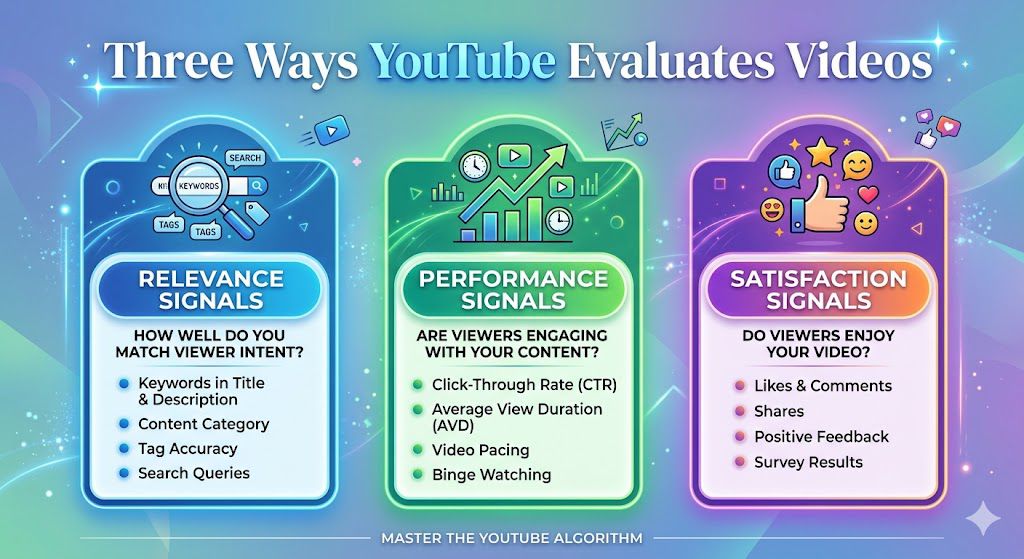
Understanding how YouTube evaluate video as faceless channel Creator
YouTube doesn’t “push” your videos to people. Instead, when a user opens their home feed, the system “pulls” the most relevant, high-satisfaction content to display to them. To win this game as a faceless creator, you need to understand how the platform evaluates your video, below are three ways YouTube evaluate videos.
- Relevance Signals: The algorithm uses your titles, descriptions, and the transcript of your video to understand the topic. It then matches that topic to users who have a history of watching similar content.
- Performance Signals: Once a video is shown to a small group (impressions), the algorithm watches how they react. If they click (CTR) and stay (Retention), it “pulls” the video into a larger audience pool.
- Satisfaction Signals: This is the 2026 priority. Beyond just watching, the system tracks “post-watch” signals. Did the user subscribe? Did they click on another one of your videos? Did they respond to a survey about the quality of the video?
Leveraging YouTube average views duration to beat algorithm.
In a traditional vlog, a viewer’s gaze is anchored by the creator. If the story slows down, the human connection keeps them watching. In a faceless channel, that anchor is gone. Without a face, the viewer is subconsciously looking for an excuse to click away. If your visuals are stagnant or your audio is flat, the viewer will “bounce” within the first 30 seconds.
To maintain high AVD (Average View Duration), you must replace the human connection with high-velocity visual and narrative engagement.
When a viewer isn’t watching a person, their eyes are prone to wandering. Your editing must act as a “pattern interrupt” to reset their focus.
Avoid holding a single stock footage clip for more than 3–5 seconds. If the topic requires a longer explanation, use motion graphics, text callouts, or zoom-ins/zoom-outs on the existing footage to keep the screen dynamic.
Aim to change your visual medium every few seconds. For example: Stock footage -> Motion graphic overlay -> Split screen with text -> Close-up detail. This constant movement mimics the dynamism of a human speaker’s gestures.
The Golden Rule for Faceless Retention:
If you were to watch your own video on mute, would you still understand the story? If the answer is “no,” your visuals are not working hard enough. If the answer is “yes, but it’s boring,” your pacing needs to be faster.
Let’s look at strategies that can help, your faceless YouTube channel succeed in 2026
Strategies for Faceless channels Success and how to beat algorithm
Recent algorithm updates now prioritize channels that demonstrate clear human oversight, transparent use of AI, and high-value, original insights.
you must pivot from “automation” to “authenticity and authority.”
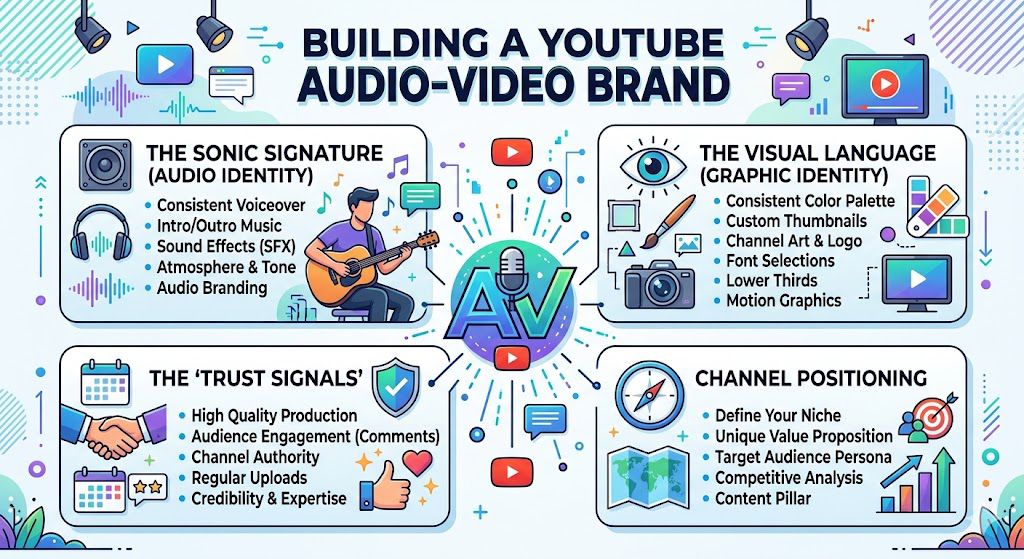
Build your audio visual brand.
In a faceless channel, your branding is the “surrogate personality.” Because the viewer doesn’t have a human face to anchor their trust, your audio-visual identity must work overtime to bridge that gap. Consistency isn’t just about aesthetics; it’s about signaling to the viewer that your channel is a reliable, professional, and trustworthy media entity.
When you remove the human face, the brand becomes the face. Here is how to construct an identity that viewers can recognize, trust, and return to.
In a faceless channel, your audio is 50% of the experience. It is the primary way you establish the “vibe” and authority of your channel.
Whether you use your own voice or an AI-powered voice model, do not change it. Your audience identifies you through the sound of the narration. If you use AI, choose a voice that aligns with your niche (e.g., a calm, steady voice for meditation/ASMR or an energetic, punchy voice for tech reviews).
Develop a “soundscape.” This includes the background music beds you use, your channel’s intro/outro sound stings, and recurring sound effects for transitions or key points. Over time, a viewer should be able to hear your video in the other room and immediately know which channel they are watching.
The Visual Language (Graphic Identity)
If your content is “faceless,” your graphics must be “distinctive.” Your goal is to move from generic stock footage to a branded visual style.
Rule: Limit your brand to a 2–3 color palette. Use these colors in your thumbnails, your lower-thirds, your background overlays, and your channel banner. This creates a visual “thumbprint” that makes your content instantly recognizable in the YouTube search feed.
Pick two fonts—one bold “display” font for titles and thumbnails, and one clean “body” font for on-screen text. Stick to these exclusively. Sloppy or inconsistent typography makes a channel look like a “content farm,” whereas consistent typography makes it look like a professional media brand.
To maintain scale without losing quality, create a library of reusable assets (thumbnail templates, intro animations, transition wipes, and title cards). This ensures that every video feels like part of a coherent series.
The channel positioning
Even without a human face, your channel must have a personality. This is your “Verbal Identity.”
Define Your Tone: Is your channel the “Expert Tutor” (authoritative, precise, fast-paced), the “Witty Observer” (playful, sarcastic, conversational), or the “Relaxed Guide” (empathetic, slow, calm)?
Your brand identity is ultimately a promise. When a user clicks on your video, they are making a bet on their time. A strong brand tells them exactly what they are getting: “This channel provides 10-minute, high-quality deep dives into [Topic] without the fluff.”
The “Trust Signals”
Because faceless channels are often associated with low-effort content, you need to intentionally inject “trust markers”:
- Quality Control: High-definition visuals, clear audio, and zero typos are the bare minimum.
- Transparency: Even if you don’t show your face, link to a legitimate website, a professional business email, or a community Discord. It signals to the viewer that a real, accountable person is behind the operation.
- The “Face” of the Brand: If you want to lean into the brand identity, consider creating a simple, iconic mascot, logo mark, or recurring graphic element that viewers can associate with the channel, acting as a visual anchor in the absence of a creator’s face.
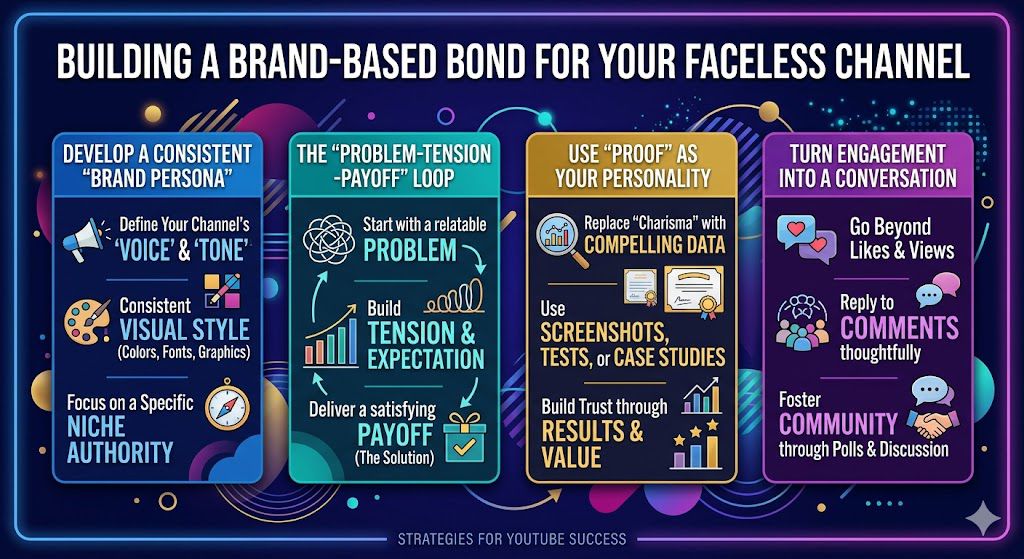
Building a Brand-Based Bond
In traditional vlogging, viewers feel a “parasocial relationship” with the creator—they feel like they know your personality, your quirks, and your journey. In a faceless channel, you must replace this “person-to-person” connection with a “person-to-brand” connection. Your audience isn’t here for you; they are here for the transformation your content provides.
Here is how you anchor that connection through storytelling:
In a faceless channel, you must replace this “person-to-person” connection with a “person-to-brand” connection.
Develop a Consistent “Brand Persona”
Even without a face, your channel must have a personality. Think of your channel as a character. Is your brand the “No-Nonsense Expert” who gets straight to the point? The “Curious Storyteller” who digs into mysteries? Or the “Calm Guide” who makes complex topics simple?
Consistency is the soul of branding. Use the same tone in your scripts, the same pacing in your editing, and the same visual style in your thumbnails. When a viewer clicks your video, they should feel like they are entering a familiar, reliable space—every single time.
The “Problem-Tension-Payoff” Loop
Without a human face to keep the viewer’s attention, your narrative structure must work harder. Every video should follow a tight storytelling arc:
Start by identifying a specific pain point or question your viewer has (e.g., “Why are your YouTube views flat despite consistent uploads?”).
Use evidence, data, or a narrative mystery to show why the problem matters and what happens if it isn’t solved. This keeps them watching.
Deliver the actionable solution or the “aha!” moment. This creates a “win” for the viewer. When you consistently deliver these wins, the viewer starts to trust your brand as a source of truth, creating a deep, lasting loyalty.
Use “Proof” as Your Personality
If you can’t show your face, show your results. In the faceless world, authority is the new intimacy. Instead of saying “I think this works,” show screenshots of analytics, share specific case studies, or provide step-by-step documentation of a process.
Even without showing your face, you can share the “messy parts” of the process. Show the research, explain the failures behind a strategy, or provide an “insider’s view” of how you get things done. This vulnerability signals to the viewer that your channel is a real entity working for them, not just a faceless content farm.
Turn Engagement into a Conversation
A parasocial connection is a two-way street, even if you’re “faceless.”
Treat your comment section like a laboratory. Ask your viewers specific questions at the end of every video to prompt discussion.
When you create follow-up content, mention specific insights or questions from the comments. When a viewer sees their own idea addressed or their question answered, it validates their participation and cements their loyalty to the brand.
“audience sentiment”—a metric YouTube’s AI is increasingly leveraging to distinguish high-value content from “AI slop.”
To beat algorithm know that your comment section is YouTube algorithm proxy
Many creators treat the comment section as an afterthought. For a faceless channel, this is a fatal mistake. The comment section is not just a place for “feedback”—it is a direct, real-time diagnostic tool that the algorithm uses to determine if your content is “soulless” or “significant.”
YouTube’s algorithm has evolved to scan the tone and depth of your comments
If your comments are filled with generic “great video” bots or, worse, viewers calling out your content as repetitive, recycled, or robotic, the algorithm flags this as “low satisfaction.” This leads to a drop in reach because the system perceives the content as failing to provide genuine human value.
Conversely, when your audience asks questions, debates a point from your video, or shares their own experiences, you are telling the algorithm: “This content is compelling enough to stop a viewer from scrolling.”
Conclusion
It is easy to get caught up in the technicalities of SEO, metadata, and the constant rumors about “what the algorithm wants.” But when you strip away the complexity, the reality of YouTube in 2026 is refreshingly simple: The algorithm is completely indifferent to your face.
It does not care who you are. It does not care if you have a high-end camera or if you are using AI tools to build your visuals. It is, however, hyper-sensitive to one thing: the viewer.